Watch the masterclass
 Angel Investing Masterclass
In short
- Read a deck in order: the problem, the founder, then the market.
- At the earliest stage you are backing the founder; the product will likely change.
- Most returns come from a few winners, so spread your money across many startups.
Chapters
- Why angel investing (opens on YouTube)
- Reading a pitch deck (opens on YouTube)
- What makes him invest (opens on YouTube)
- Red flags (opens on YouTube)
- Advice to new angels (opens on YouTube)
- Margins that matter (opens on YouTube)
- How to keep learning (opens on YouTube)
Key takeaways
- Problem, founder, market. Then go-to-market, business model and who else has invested.
- Stage changes what you weigh. At pre-seed, back the founder; later, look for a product that is clearly and lastingly better.
- Red flags: a founder who can't explain the problem simply, earlier investors not putting in more, weak accounts or compliance, or a raise far bigger than the plan needs.
- Watch the cap table. A founder diluted heavily early has little left to work for, and later investors notice.
- Diversify. A few winners drive most returns, so a handful of bets is too few.
- Valuation is an output. It follows from how much is raised and how much is given away; a very cheap entry can mean nobody else wants in.
- Work on your deal flow. Widen what you understand by learning from sector experts.
In his words
“Angel investing is a lonely journey. It is patient capital, and it is risky.”
9:20
“Your portfolio is as good as the deal flow you're looking at.”
31:34
“Valuation is actually just an output.”
35:01
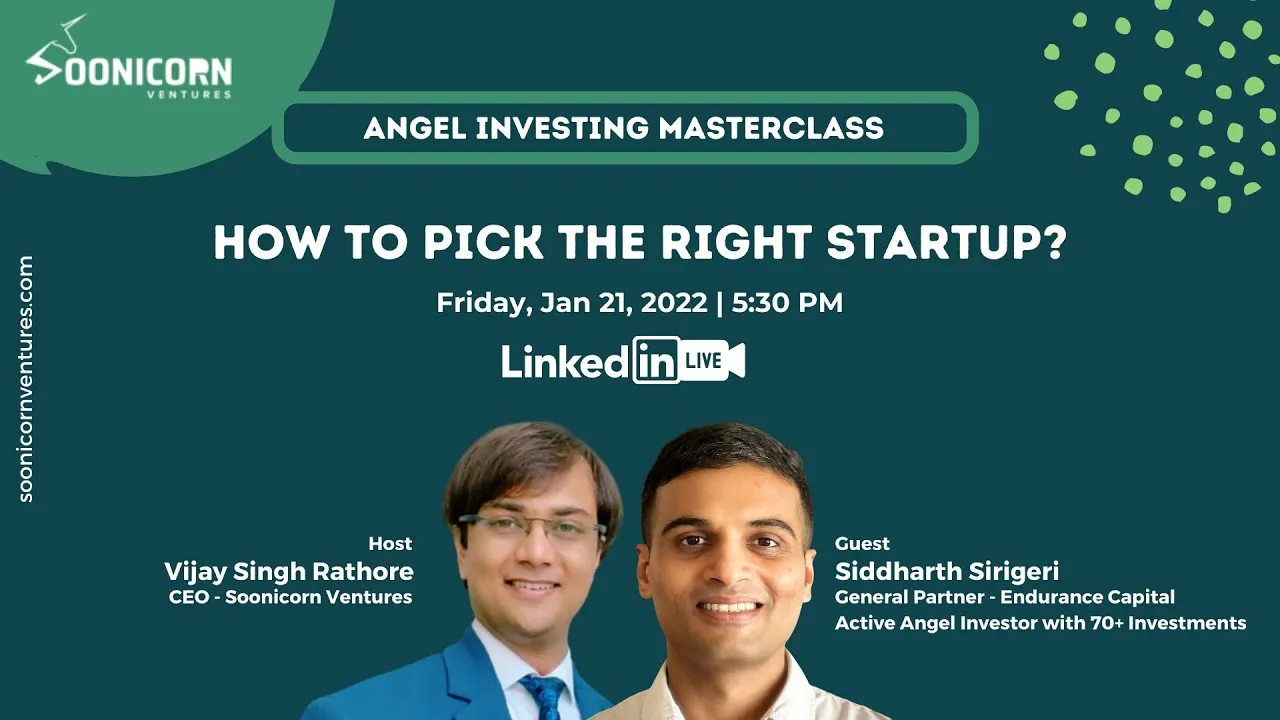
Guest: Siddharth Sirigeri, angel investor in 70+ startups.
Views in this session are the speaker's own and are not investment advice. Most startups fail; startup investing is high-risk and long-term, and you can lose your capital.

Hosted by Vijay Singh RathoreCo-Founder & CEO of Soonicorn Ventures.